
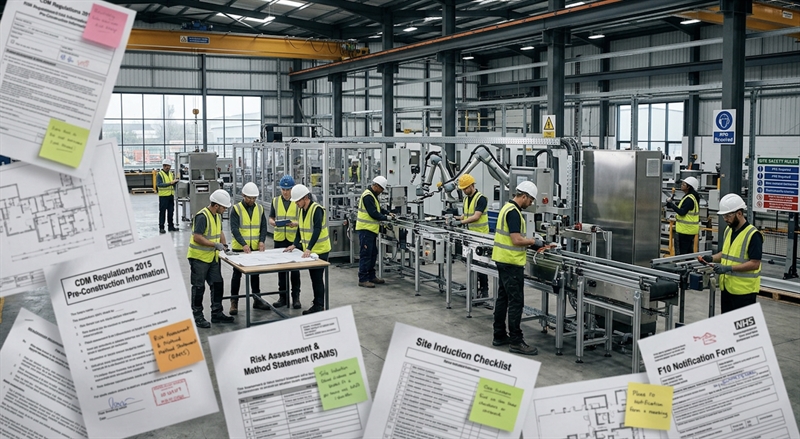
A factory installs a new production line. A warehouse adds a mezzanine. A laboratory alters extraction
ducting. A food plant replaces pipework and conveyors. None of these organisations see themselves
as "construction companies". Yet because the work involves a "structure", they can suddenly find
themselves facing Principal Designers, Principal Contractors, Construction Phase Plans and a pile of
paperwork that feels completely out of proportion.
The problem lies in the definition.
CDM 2015 defines construction work very broadly. It also defines a structure very broadly. A
conveyor, fixed plant, pipe bridge, platform, tank, ducting system or mezzanine can all be treated as a
structure. That means work which is really engineering, maintenance or contractor management can
become construction in the eyes of the law.
The Practical Problem
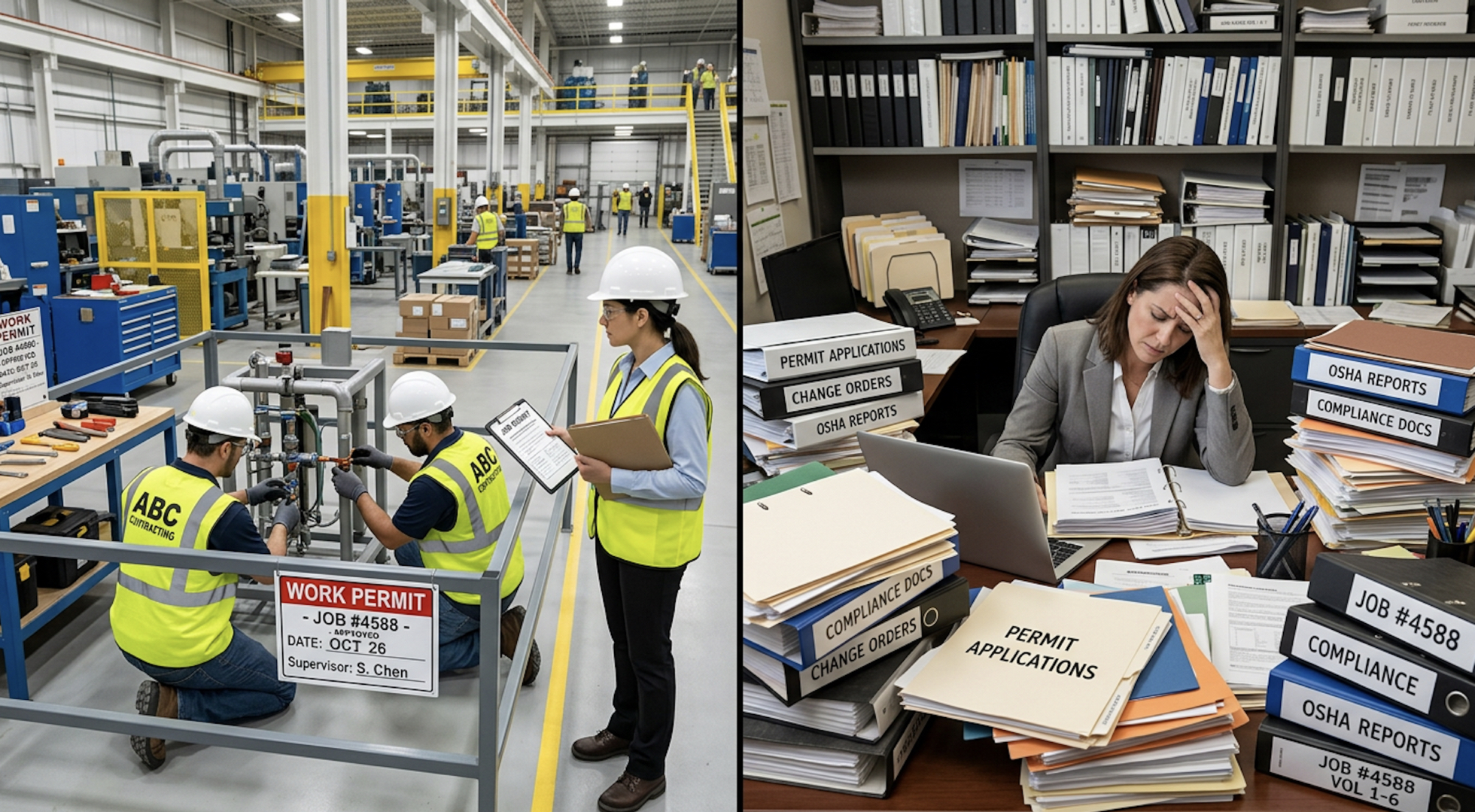
The law is effectively binary:
- Either CDM applies
- Or it does not
Real life is not that simple.
Many organisations already have excellent contractor controls:
- Approved contractor systems
- Competence checks
- Risk assessments and RAMS
- Permit to work systems
- Isolation procedures
- Supervision and coordination
In many cases, those controls are more than enough to manage the work safely.
A new production line can often be installed safely using:
- Good planning
- Competent contractors
- Clear supervision
- Isolation and permit controls
- Proper coordination between trades
No one is made safer by adding fifty pages of generic construction paperwork.
Where CDM Creates Confusion
A factory may be told it needs:
- A Principal Designer
- A Principal Contractor
- A Construction Phase Plan
- Formal appointments
Yet the work may simply involve two engineering contractors replacing a line over a weekend
shutdown.
The result is that organisations are pushed into one of two bad options:
- Ignore CDM completely and hope for the best
- Create a construction-style bureaucracy for every small project
Neither approach is sensible.
A More Practical Test
The better question is not:
"Does this involve a structure?"
The better question is:
"Does this work genuinely need the type of planning and coordination that CDM was designed for?"
In practice, ordinary contractor control is usually enough where the work is:
- Like-for-like
- Low risk
- Routine
- Managed by one contractor
- Does not involve significant design
- Does not introduce major construction hazards
However, a more formal CDM approach is likely to be justified where the work:
- Involves more than one contractor
- Requires design decisions
- Changes the structure or layout significantly
- Introduces construction-type risks
- Needs coordination between multiple trades
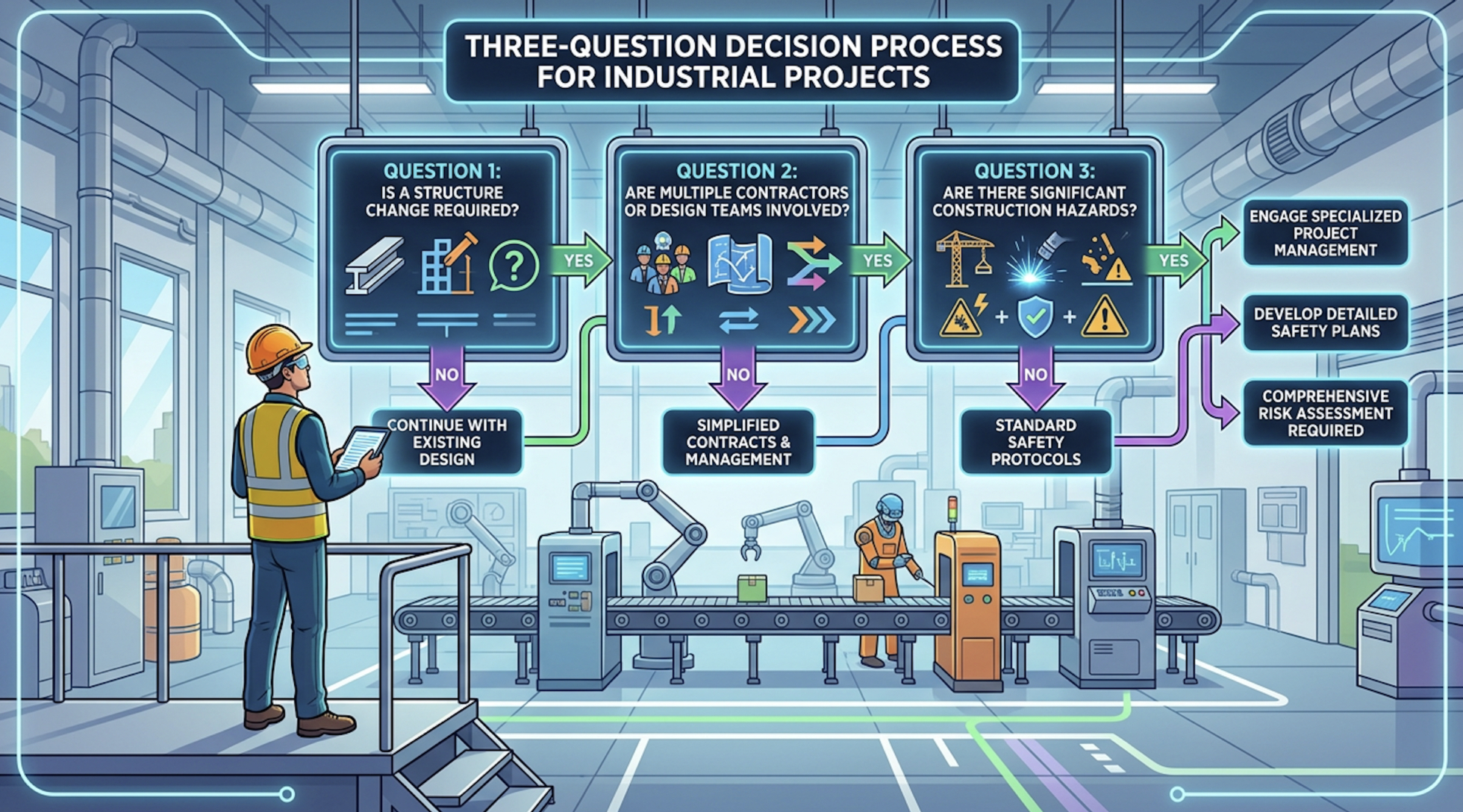
That is why we use a simple three-question filter:
- Does the work change a structure or fixed plant?
- Does it involve design, sequencing or more than one contractor?
- Does it introduce construction-type hazards such as roof work, lifting, excavation, confined
space or major isolations?
If the answer is largely "no", your normal contractor control process is probably sufficient.
If the answer is "yes", CDM may apply and should be managed proportionately.
The Real Answer: Proportionate CDM
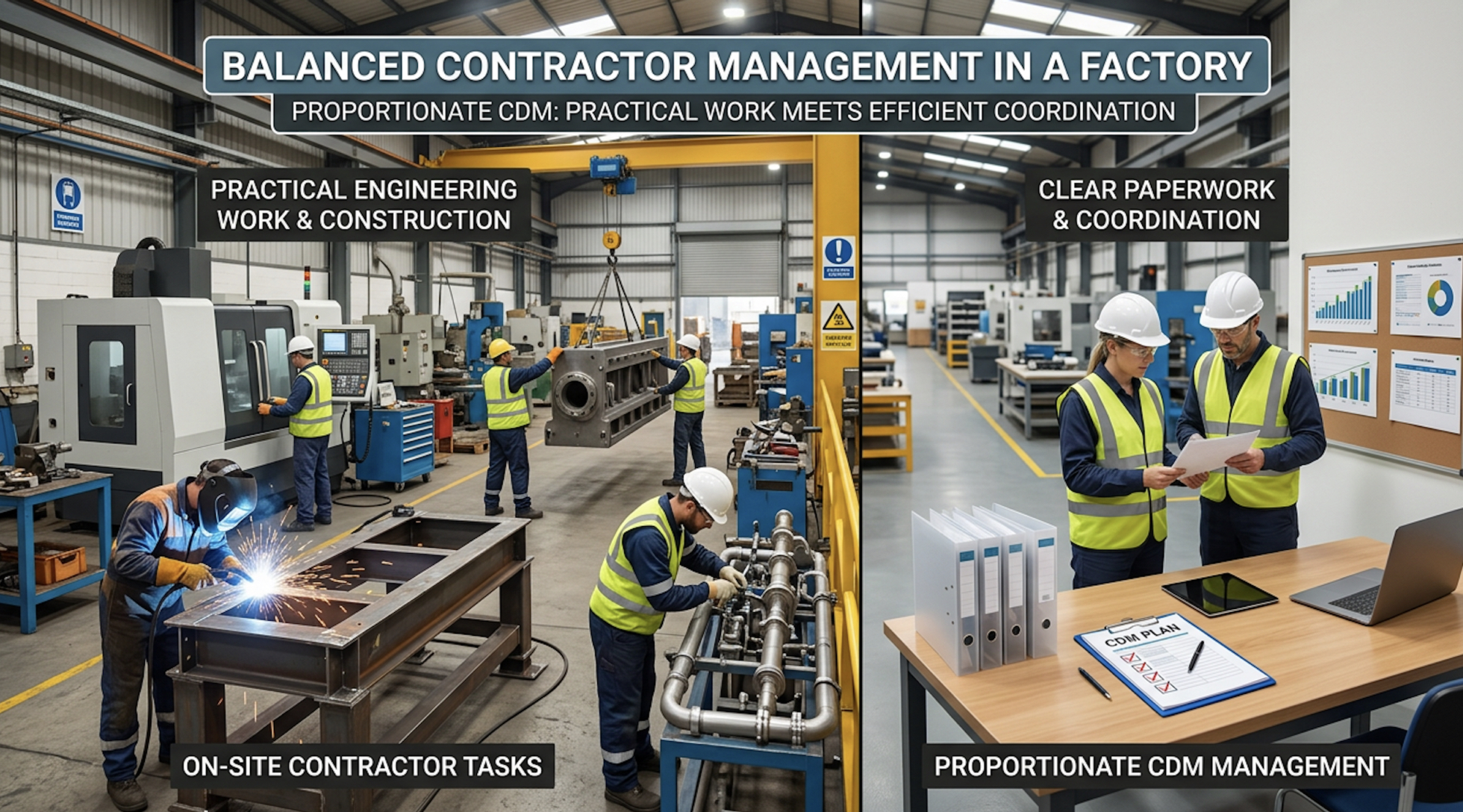
The answer is not to abandon safety controls. Nor is it to create unnecessary paperwork.
For many non-construction organisations that may mean:
- A short project brief
- Clear appointment of whoever is coordinating the work
- A simple construction phase plan of one or two pages
- Suitable risk assessments and method statements (RAMS), permits and isolations
- A short coordination meeting before work starts
In other words, enough to demonstrate that the work has been planned and coordinated properly,
without turning an engineering project into a paper exercise.
Client organisations have been legally responsible for managing contractors since long before CDM
existed. Those duties arise principally from section 3(1) of the Health and Safety at Work etc. Act
1974 and regulations 11 and 12 of the Management of Health and Safety at Work Regulations 1999.
There is also extensive case law confirming that these duties cannot simply be handed to a contractor.
In R v Swan Hunter Shipbuilders Ltd and Telemeter Installations Ltd and R v Associated Octel Co Ltd,
the courts made it clear that an employer cannot delegate its section 3(1) duties.
Section 3(1) requires every employer to conduct its undertaking so that people not in its employment
are not exposed to risks to their health or safety, so far as is reasonably practicable. The courts
confirmed that this duty extends to repair, maintenance and project work carried out by independent
contractors. In other words, if the work creates risk, the client organisation still retains responsibility
for ensuring it is properly planned, coordinated and controlled.
Finally, none of this is new. The principle that clients must plan, select, coordinate and monitor
contractors properly has been established for decades through statute, case law and HSE guidance.
The HSE’s long-standing publication, Managing Contractors: A Guide for Employers, sets out a
practical five-step approach based on planning, choosing competent contractors, managing the work,
monitoring it and reviewing performance. In many non-construction organisations, that contractor
management framework will often provide the real substance of safe project control, with CDM
applied only where genuinely necessary.
CDM should support sensible contractor management, not replace it.
If you are struggling with where the line sits between ordinary contractor control and CDM
compliance, our course explains exactly where CDM applies, where it does not, and how to manage
projects proportionately in factories, warehouses, laboratories and other non-construction
environments.